
ASB-27 - autonomous seismic buoy
Engineering R&D project for autonomous marine seismic data acquisition: buoy, hydrophone, recorder, GPS, satellite communications, position holding and application scenarios.
What is it
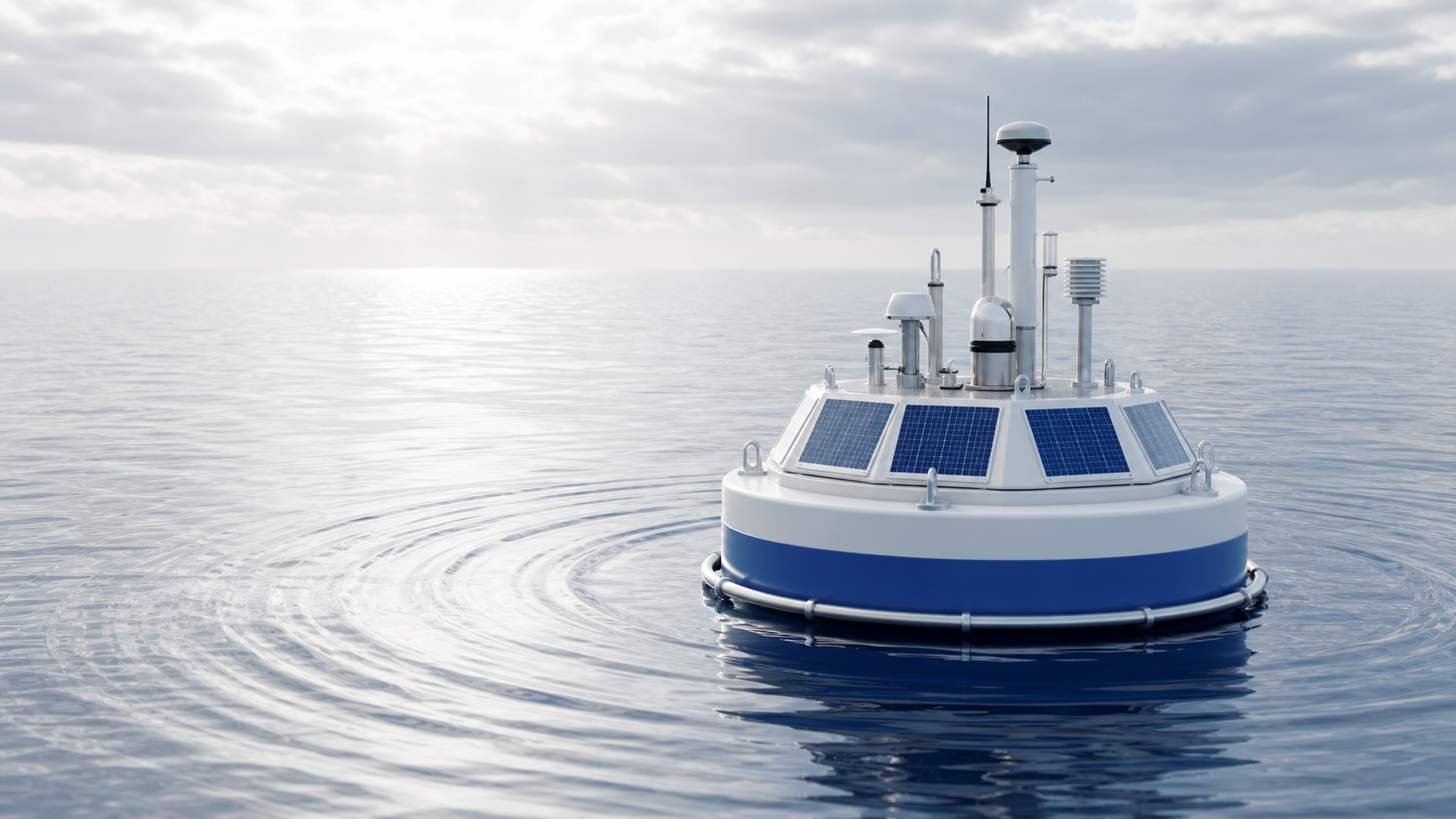
ASB-27 is an autonomous surface robot/buoy for collecting marine seismic data. The concept involves working in coordination with the main vessel, holding position, transmitting coordinates and quality control data via satellite, recording the signal with a hydrophone and further processing the data in the industry loop.
The design should be considered as an engineering technology for experimental evaluation of applicability. It is not advertised as a universal replacement for traditional marine seismic methods, but is positioned as a promising addition for challenging areas, coverage expansion and pilot scenarios.
How it works
Buoy/robot
A surface autonomous platform that can hold position and move between receiving points according to the shooting scenario.
Hydrophone
Highly sensitive hydrophone for recording marine seismic signal.
Data logger
32-bit registration system, data preparation for further processing and quality control.
GPS and satellite communications
Positioning, coordinate updating, telemetry and transmission of control information.
Pilot System
Operator loop for managing a large number of active nodes, routing, obstacle avoidance and coordination with the main ship.
Enterprise Integration
The industrial scenario requires connectivity with customer data, reporting, security, regulations, signal processing and industry processes.
Application scenarios
3D shooting and 4D monitoring
Collect data for pilot 3D and 4D seismic monitoring scenarios where repeatability, coverage and quality control are important.
Addition to towed streamers
Expansion of azimuths and registration offsets as a complement to 2D/3D towed streamers in difficult conditions.
Hard to reach and blind spots
Potential data recording in areas near platforms, structures, restricted areas and complex offshore infrastructure.
Energy infrastructure
Assess applicability near offshore energy facilities, industrial structures, subsea infrastructure, and areas where classical data acquisition is limited.
Experienced industrial pilots
Technical and economic assessment of the applicability of technology for a specific object, area of work, geological task and operating limitations.
Energy Industry Connection
ASB-27 is associated with the energy industry through the tasks of safely collecting engineering and seismic data around marine and coastal infrastructure. For energy companies, this can be useful in pilot scenarios for monitoring complex areas, assessing the condition of an operation area, expanding data coverage, and preparing a technical feasibility study before scaling up.
Marine energy
Experimental assessment of the applicability of autonomous buoys near marine energy facilities, technological structures and areas where it is necessary to minimize the impact on existing infrastructure.
Subsea infrastructure
Scenarios where it is important to obtain additional data around communications, passages, platforms, industrial facilities and areas with cross-functional delivery geometry.
Industrial safety
The pilot must consider shipping traffic, restricted areas, communication conditions, operator roles, operating procedures, information security and data quality control.
Digital Data Loop
For the energy sector, not only signal registration is important, but also further processing, storage, tracing, reporting and integration with corporate systems.
Field testing and engineering readiness
The ASB-27 materials reflect the elements of field verification and engineering layout: satellite and inertial positioning, satellite and radio communication channel, data logger, sensors, water resistance up to 30 meters, transportation, completeness of the control system and communication equipment. The presentation specifically states keeping the station within 3 meters in strong winds and a current of 0.5 knots.
| Component | What is checked in the pilot environment |
|---|---|
| Positioning | Holding the receiving point, coordinates, influence of wind, current and sea swell. |
| Connection | Satellite channel, radio channel, telemetry, quality control, coordinates update. |
| Registration | Hydrophone, 32-bit recording, signal quality, data suitability for further processing. |
| Control | Pilot System, active nodes, routes, obstacle avoidance, closed areas, maritime traffic. |
| Operation | Transportation, container mobilization, completeness, personnel training, regulations. |
What is required for industrial applications
For industrial use of ASB-27, you need not only an engineering prototype, but also a clear design route: technical characteristics, testing, economic justification, pilot scenario, agreement with the customer, operating regulations, safety and integration with customer processes.
Technical session
Objectives, work area, constraints, geological task, existing survey configuration and success criteria.
Pilot script
Receiver Points, logistics, number of devices, communications, operators, quality control, safety and interaction with the ship.
Data Evaluation
Registration, processing, signal quality, comparison with alternative methods and usefulness for the customer's task.
Economics and risks
Cost, logistics, weather windows, operational constraints, security, reliability and scaling requirements.
Road map
Decision on continuation: re-pilot, expansion, integration with the enterprise landscape or technology adjustment.
Realistic application niche
ASB-27 is better positioned as a promising engineering technology that can complement traditional marine seismic methods in challenging scenarios. The key value is not the promise to replace all existing solutions, but the ability to explore new data collection configurations where standard methods face limitations.
Materials
PDF describing the technology design, application scenarios, Pilot System, field testing and engineering layout.
Discuss a similar project
Tell us about your task and outline - we’ll show you how to apply this experience to you and offer the first practical step.