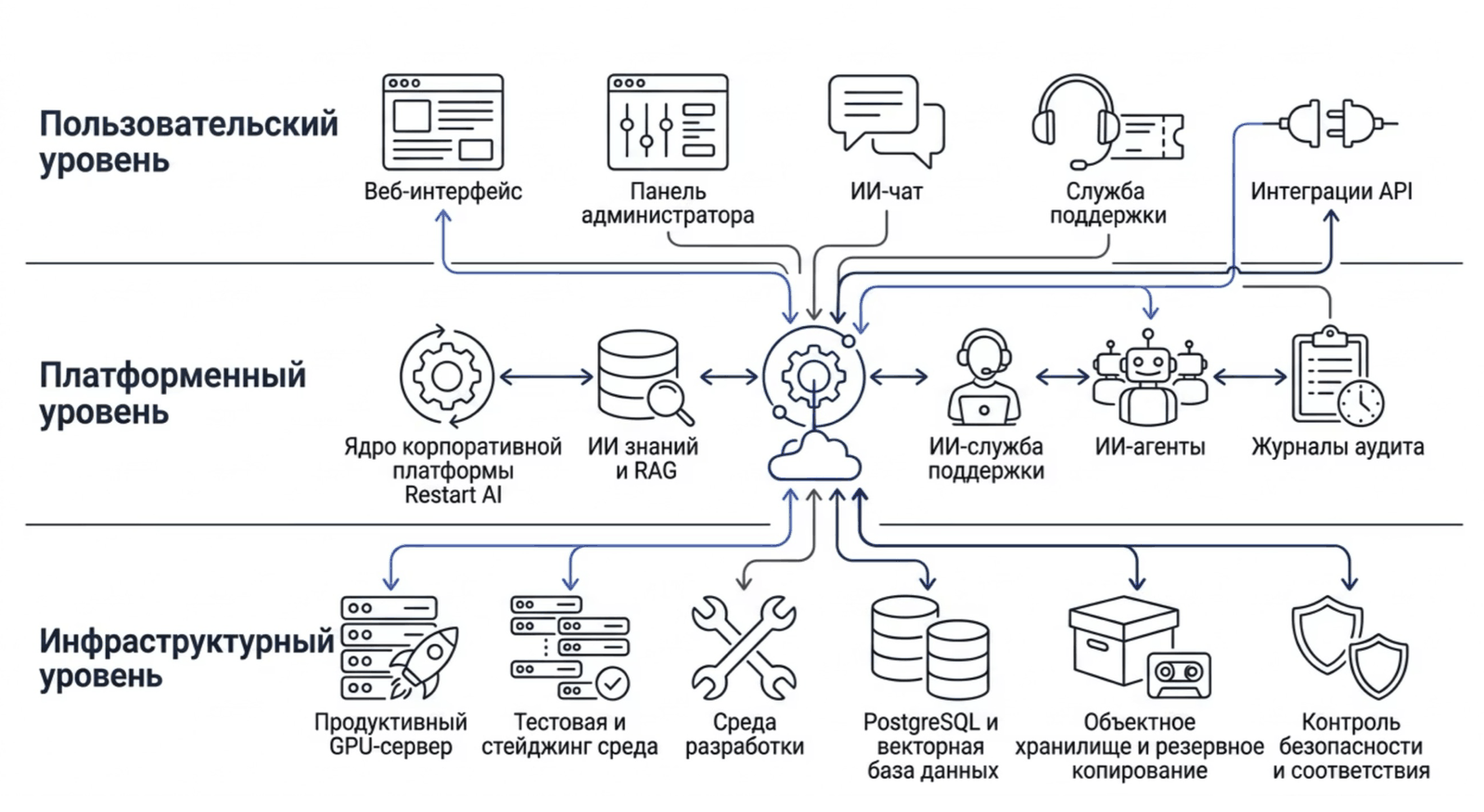
Typical platform outline: web interface, backend API, PostgreSQL database, vector storage, file storage, task queue and handlers, LLM adapters, GPU node and monitoring. Below are resource guidelines for each environment; the specific configuration depends on the number of users, frequency of requests and selected models and is recorded in the technical specifications.
| environment | Purpose | Example resources |
|---|
| Development | Development, debugging, experiments | 4–8 vCPU, 16–32 GB RAM, 150–300 GB SSD, GPU as needed |
| Test / Staging | Pilot, checking releases and integrations, acceptance | 8+ vCPU, 32+ GB RAM, 300+ GB SSD/NVMe, L4 / A10 / L40S or task equivalent |
| Production | User experience, API, AI chat, RAG, knowledge bases | 16+ vCPU, 64–128+ GB RAM, 1+ TB NVMe, L40S 48 GB / A100 80 GB or equivalent as agreed |
| Backup / Storage | Backups, source documents, logs | Separate storage environment with regulations for storing and unloading data |
The GPU is not always needed: it is required for local LLM, embedding, reranking, processing large amounts of documents and high-load scenarios. For some scenarios, a CPU environment or external LLM providers according to an agreed architecture are sufficient.
Example from bank case: pilot worked on 2 × A5000 24 GB (2 parallel threads to the GPU), production in the internal loop - on 4 × A5000 24 GB (6 threads); 2 × A100 80 GB are provided for external users, parameters are specified after load testing.