
Document AI: document processing for ERP, 1C, CRM and EDMS
Document AI recognizes the document type, extracts attributes and tabular parts, checks data quality and transmits the result to corporate systems.

Positioning
Document AI is needed by companies where documents remain the bottleneck of digitalization: contracts, invoices, acts, applications, primary documents, scans, archives, procurement materials and internal forms require manual processing.
The product helps reduce manual entry, improve data quality, speed up document loading into ERP/1C/CRM/EDS and prepare the basis for AI search, contract analytics and migration projects.
What does the client get?
Less manual input
Documents are classified, attributes are extracted, tabular parts are structured.
Better data
Fields are checked against rules, reference books and business logic before being sent to the system.
Faster processing
The incoming flow of documents can be sent to ERP, 1C, EDMS or CRM without manual sorting.
AI Ready
The extracted data becomes available for RAG, analytics, contractual control and BI.
Functionality
Classification
Determining the document type, processing route and target system.
Extraction
OCR, details, amounts, dates, sides, tabular parts, positions and applications.
Examination
Completeness control, reference books, rules, duplicates, exceptions and manual verification.
Broadcast
API, queues, downloads to 1C, ERP, CRM, EDMS, archive and data marts.
Architecture and Integrations
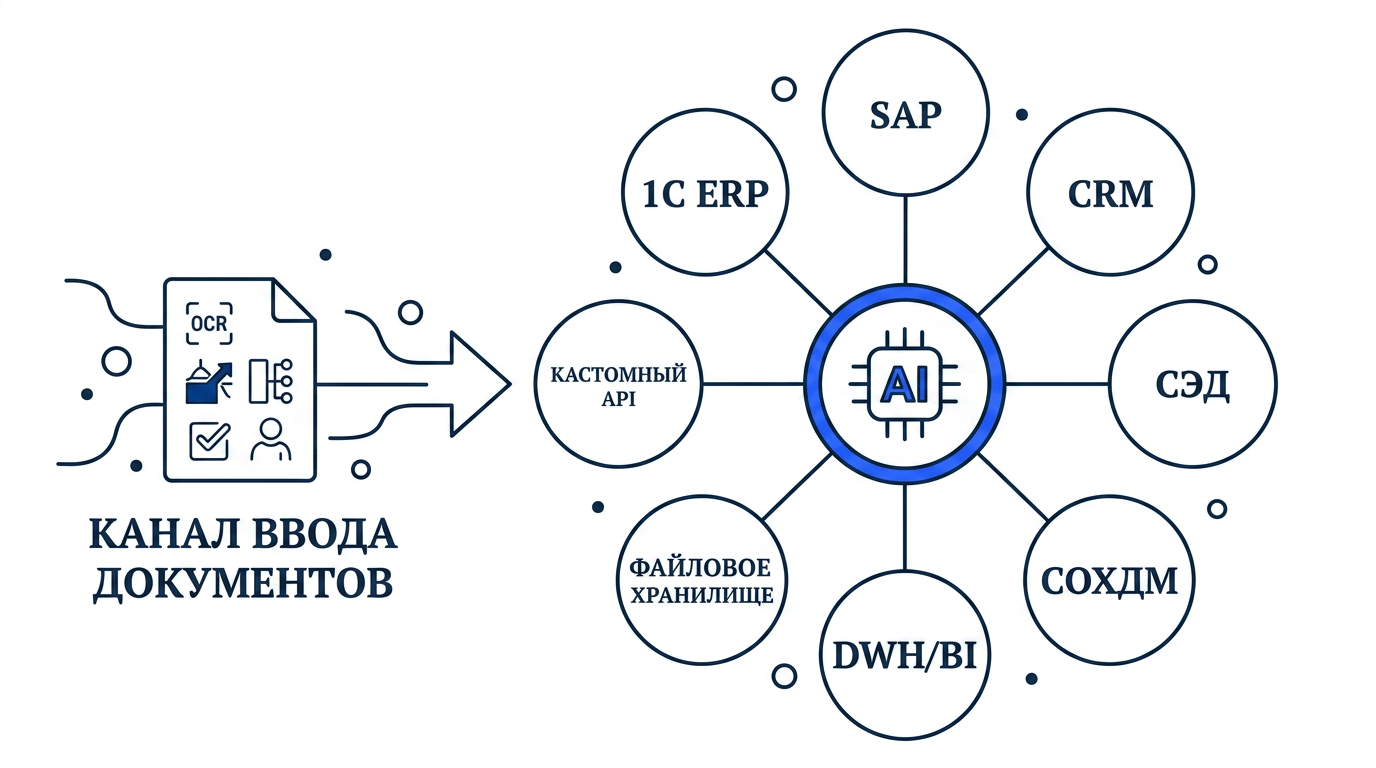
Document AI includes an input channel, OCR, classifier, extraction layer, quality rules, human review for controversial cases, logging and integration layer.
Integrations: 1C:ERP, 1C:Document Management, SAP, CRM, EDMS, DWH, BI, corporate portal, mail, file storage and customer API.
Safety and Operation
Documents often contain personal data, trade secrets and contractual terms, so the architecture takes into account access rights, storage loops, masking and depersonalization of data, logging and requirements of Federal Law No. 152-FZ.
Roles and access rights
Separation of users, administrators, data owners and process operators.
Magazines
Recording actions, requests, sources, settings changes and important events.
Data control
Working with permitted sources, storage rules, masking and PD restrictions.
Support
Operating regulations, monitoring, updates, SLA/OLA and post-pilot development.
Pilot and implementation
Scenario selection
We formulate the business problem, process owner, data sources, information security restrictions and result criteria.
Quick assembly
We raise the outline, connect data, configure roles, prompts, templates, integrations and logging.
Checking the effect
We conduct a pilot on real scenarios, collect feedback, compare manual and automated processes.
production launch
We draw up the architecture, regulations, SLA, support, training and scaling roadmap.
It is better to start a pilot with one class of documents with a sufficient volume of examples: contracts, invoices, acts, applications, procurement documents or an archive for SAP → 1C migration.
Frequently asked questions
What documents can be processed?
Agreements, acts, invoices, applications, questionnaires, scans, PDF/DOCX/XLSX and other corporate documents.
Does Document AI integrate with 1C and ERP?
Yes. The extracted attributes can be transferred to ERP, 1C, CRM, EDMS and DWH.
Is it possible to start without full automation?
Yes. The pilot can check one class of documents and a limited set of attributes.
Analysis of primary documents is one of the direction scenarios AI for 1C.
Request a demo or pilot
We will show the product on your environment and offer a pilot format with a clear output result.