
Audit of readiness for the digital ruble
In 10 working days, RESTART helps you understand which systems, processes, roles and risks will be affected by the digital ruble, what needs to be prepared before connecting, and which first pilot makes sense to launch without unnecessary restructuring of the IT landscape.
Login Format
The digital ruble readiness audit is a short managerial and technical stage before a large project. It is needed so as not to start with procurement, urgent development or scattered meetings, but first to get a clear map: which processes are affected, which systems will need to be modified, where there are information security risks, who should participate and which scenario is reasonable to test first.

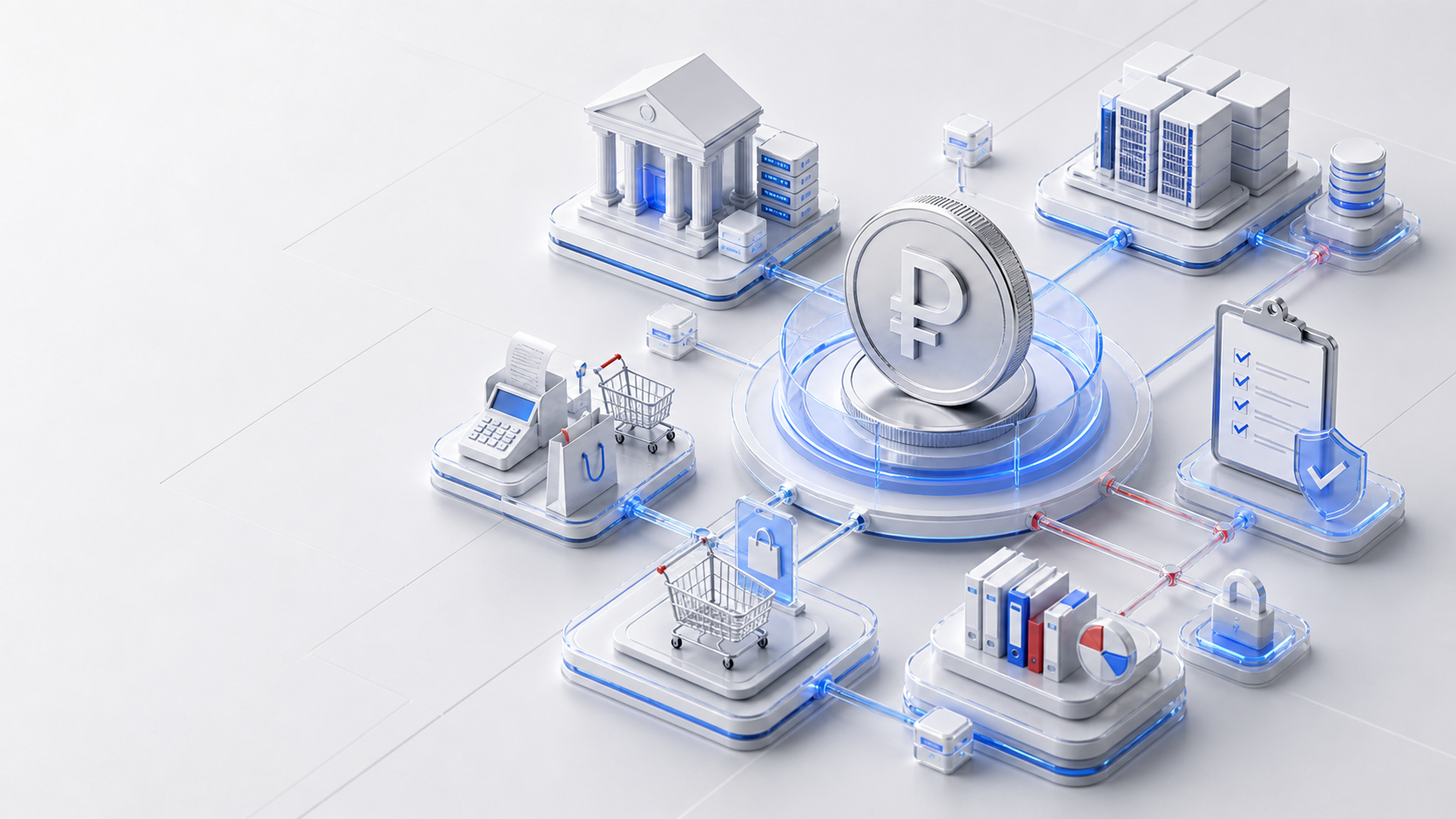
Official sign of the digital ruble. In August 2026, the Bank of Russia introduced the official symbol of the digital ruble - a ruble sign inscribed in a circle. On the RESTART pages about the digital ruble, this particular sign is used.
The digital ruble is already operating in mandatory mode for the first wave of companies: what the first weeks after September 1, 2026 showed — Bank of Russia statistics, business fees, user reviews, and a preparation checklist.
For whom it is especially useful
Bank
To evaluate improvements to remote banking services, client channels, integrations, logging, roles, support and interaction with the digital ruble platform through the Bank of Russia environment.
Retail and trading network
To understand how the digital ruble will affect cash registers, websites, mobile apps, returns, reconciliation, loyalty programs, revenue accounting, and cooperation with partner banks.
Online store
To check in advance the customer's payment path, order statuses, returns, personal account, fraudulent transaction control, notifications, payment partner software interfaces and accounting entries.
Financial and IT block
So that the CFO, IT director, information security director and head of the payment department receive one common language: what is changing in the processes, what risks are there, how many teams are involved and what needs to be decided before the pilot.
What is important to understand in advance
The digital ruble is a digital form of the Russian national currency. A digital ruble account is opened on the Bank of Russia’s platform, with access provided through participating banks. One cash, non-cash, and digital ruble are equivalent.
For business, the practical question sounds simpler: what user, payment, accounting, integration and information security processes need to be prepared so that the new payment method does not become a separate manual environment. Therefore, the RESTART audit does not focus on retelling the concept, but on the readiness of a particular organization for change.
Official context: Bank of Russia page about the digital ruble.
Implementation timeline and regulatory context
The timelines and thresholds below are based on materials from the Bank of Russia and do not substitute the original sources: verify the conditions of applicability and exceptions against the current version of regulatory acts effective on the date of your decision. According to Bank of Russia materials, the ability to conduct operations with digital rubles should be rolled out in stages: starting 1 September 2026—by the largest banks and trading companies from the relevant segment with revenue exceeding RUB 120 million in the previous year; starting 1 September 2027—by banks holding a universal license and trading companies with revenue exceeding RUB 30 million; starting 1 September 2028—by banks holding a basic license and trading companies with annual revenue between RUB 20 million and RUB 30 million. Separate exceptions are specified for retail outlets with revenue below RUB 5 million and for areas without internet access.
These deadlines do not mean that businesses need to wait until the last quarter before the mandatory milestone. Preparation covers agreements with banks, payment scripts, cash flow, accounting, returns, reconciliation, information security, user support, test benches and internal regulations.
Key Terms, Plainly Explained
| Term | Clear in Russian | What to check in a company |
|---|---|---|
| Digital ruble | The third form of the ruble along with cash and non-cash. | What payment and accounting processes should be able to work with the new form of payment. |
| Digital ruble wallet | An account on the digital ruble platform, to which the client receives access through the bank. | Which customer channels, roles, notifications, and transaction statuses are affected. |
| Remote banking | Mobile banking, online banking and other remote client channels. | What interfaces, support and integration scenarios should be ready. |
| Accounting environment | ERP, 1C, accounting systems, registers, postings, reconciliations and reports. | How to record transactions, returns, commissions, period-end closing and control reports. |
| Information security | Access, logs, cryptography, monitoring, data protection and activity control. | What roles, events, keys, certificates, logs and regulations are needed for safe operation. |
| Pilot | Limited testing of one or more scenarios prior to production launch. | Which scenario will provide maximum understanding with minimal risk: payment, return, reconciliation, report, support. |
What we check in 10 working days
Role of the organization
We determine who you are in the digital ruble scenario: a bank, a retail chain, an online store, a large recipient of payments, a service operator or a participant in the internal payment environment.
Payment scenarios
We analyze payments, returns, cancellations, partial returns, transaction statuses, customer support, disputes and reconciliation with the bank.
Systems and Integrations
We map cash registers, website, application, personal account, ERP/1C, accounting, data storage, reporting, payment gateways and service support.
Accounting and control
We check how transactions will be recorded, how the day is closed, how reconciliations are built, what reports are needed by the financial unit and internal control.
Information security and operation
We look at access rights, logs, cryptography, test benches, monitoring, administrator roles, regulations, incidents and maintenance requirements.
Preparation plan
We create a readiness matrix, a list of risks, a first pilot, a team, control points and a clear road map.
Editions and volume limits
The complexity and responsibility differ between the bank and the trading organization, so the package is divided into two editions. The term in both is 10 business days.
| Parameter | Trading organization | Bank |
|---|---|---|
| Perimeter | one legal entity, one sales channel—the online store or one standard cash register system | one legal entity and one selected customer channel |
| Processes and systems | up to four processes and four systems, one partner bank | up to five processes and six systems |
| Exchange interfaces | up to five | up to eight |
| Interview | up to six | up to ten |
| Documents | up to 15 documents, up to 300 pages | up to 25 documents, up to 600 pages |
Surveying the remaining channels and the entire banking landscape is a separate scope of work.
What is needed from the client
- involvement of payment business, IT, information security, accounting, legal function, and support;
- current process and integration diagrams;
- for the bank — the current requirements and specifications for interacting with the platform available to it;
- for a trading organization — the terms and technical materials of the selected partner bank.
If specifications are absent, the result is limited to management readiness and a list of questions for the partner bank—it does not constitute a confirmed technical connection project in this case.
What is not included
- connection to the bank's platform or services;
- development of remote service systems, cashier software, and payment interfaces;
- tests with the Bank of Russia;
- acquisition of protective equipment, certification and accreditation;
- regulator's approval of decisions;
- legal guarantee of performance of an obligation by a certain date.
When the work is completed
- the affected systems, processes, roles, dependencies, and gaps have been identified for the agreed organizational role and selected channel;
- regulatory and technical conclusions are tied to the versions of sources used;
- One pilot scenario has been selected, or a justified refusal to launch it has been made until the prerequisite conditions are met.
A well-founded conclusion of "we are not launching the pilot yet" is a full-fledged audit result.
Output documents
| Artifact | Why is it needed? |
|---|---|
| Readiness Matrix | Shows which processes and systems are already ready, where there are gaps and what needs to be done before the pilot. |
| Map of systems and integrations | Connects payment scenarios with cash registers, website, application, ERP/1C, accounting, reporting, support and bank. |
| Risk register | Captures risks to information security, accounting, timing, data, integrations, operations, and customer experience. |
| First pilot's plan | Defines the scenario, participants, test data, acceptance criteria, responsibilities, and limitations. |
| Roadmap for preparation | Gives management a clear sequence of actions: decisions, improvements, purchases, tests, documents and launch. |
The package is opened by the role passport of the organization and the examined channel, while the requirements and source specifications matrix records which source versions the conclusions are based on.
Package budget
| Editorial office | Package budget |
|---|---|
| Trading organization | 300 – 600K ₽ excluding VAT |
| Bank | 0K – 2M RUB excluding VAT |
The exact fixed price is determined after the initial meeting and scope verification; included work, deliverables, and exclusions are confirmed prior to commencement; any scope expansion is possible only upon agreement.
Team composition
Solution Architect
Collects the target map of processes, systems, integrations, roles, and milestones.
Information Security Architect
Reviews access rights, logs, cryptography, test loops, monitoring and operational risks.
ERP/1C and accounting analyst
Reviews transactions, returns, reconciliations, period closing, reports and communication with the financial environment.
Business Analyst and Work Manager
Conducts interviews, records decisions, collects artifacts, and turns findings into understandable action plans.
Where RESTART Adds Value
RESTART works at the intersection of IT, information security, ERP/1C, integrations, data and project management. This is especially important for the digital ruble: the payment scenario cannot be considered separately from accounting, cash registers, customer channels, logs, access, support and reporting.
Frequently asked questions
Is an audit suitable for a non-bank?
Yes. For retail, online stores and large distribution networks, it is important to prepare the payment, cash, accounting and customer environments in advance. The bank is responsible for access to the platform, but the business needs to understand its processes and integrations.
Are you connecting to the digital ruble platform?
No. RESTART prepares IT, information security, accounting and integration environment for the customer. Access to the digital ruble platform is provided through a participating bank within the framework of the rules of the Bank of Russia.
Is it possible to start without technical specifications?
Yes. The first stage just helps to collect the initial picture: goals, scenarios, systems, owners, risks, restrictions and a list of decisions that need to be made before the pilot.
What would be a good audit result?
Not a general presentation, but a practical kit: readiness matrix, systems map, risk register, first pilot plan, team and training roadmap.
Can AI be used in such a project?
Yes, but carefully. AI is useful for searching requirements, protocols, regulations, support issues, and a project's knowledge base. Decisions on risks, access, finance and launch must be confirmed by responsible specialists.
How we fix the volume and deadline
The terms below are identical for all packages and are incorporated into the contract without changes.
- Perimeter — prior to the agreement. We hold an initial meeting of up to 60 minutes and agree on the perimeter passport: systems, processes, sources, participants, and outcomes.
- Countdown of the term. The timeline starts after the handover of the approved set of source materials, provision of access credentials, and confirmation of the interview schedule. Delays on the client's side will postpone the timeline by a corresponding amount of time.
- Data. We operate within a coordinated secure channel. Production data is not transmitted to external AI services without the customer's written permission.
- Result transmission. We provide materials in PDF and editable formats (DOCX, XLSX, PPTX, or agreed equivalents) and conduct one results defense session of up to 90 minutes.
- Acceptance. Five business days are allocated for reviewing the results. One consolidated round of clarifications within the agreed scope is included; however, correction of errors and non-compliances with the contract is not limited to this round.
- Volume change. New systems, sources, and tasks are included only upon agreed changes to scope and cost.
- Work format. The default format is remote, unless an in-person component is explicitly planned for the package.
The statuses and licenses on the basis of which the works are performed are collected on the page "Licenses and statuses".
Email us
Email us
Write to info@restart.re or click the button below. For the first letter, it is enough to briefly describe the role of the organization, payment scenarios, current systems, security restrictions and the desired time frame for the first decision.
Email usWhat to include with your request
- role of the organization: bank, retail, online store, retail chain or other participant;
- key payment scenarios: payment, refund, reconciliation, reporting, support;
- list of main systems: cash registers, website, application, ERP/1C, accounting, data warehouse;
- restrictions on information security, personal data and integrations;
- desired timing of decision or pilot.
Request format
We agree on the volume, timing and output artifact - and launch it in a short time.