
AI platform and RAG agents for a bank from the top 5 of Uzbekistan
Project under NDA: the corporate AI platform and RAG agents passed the pilot, received a positive assessment from the customer and moved into the support and replication environment.
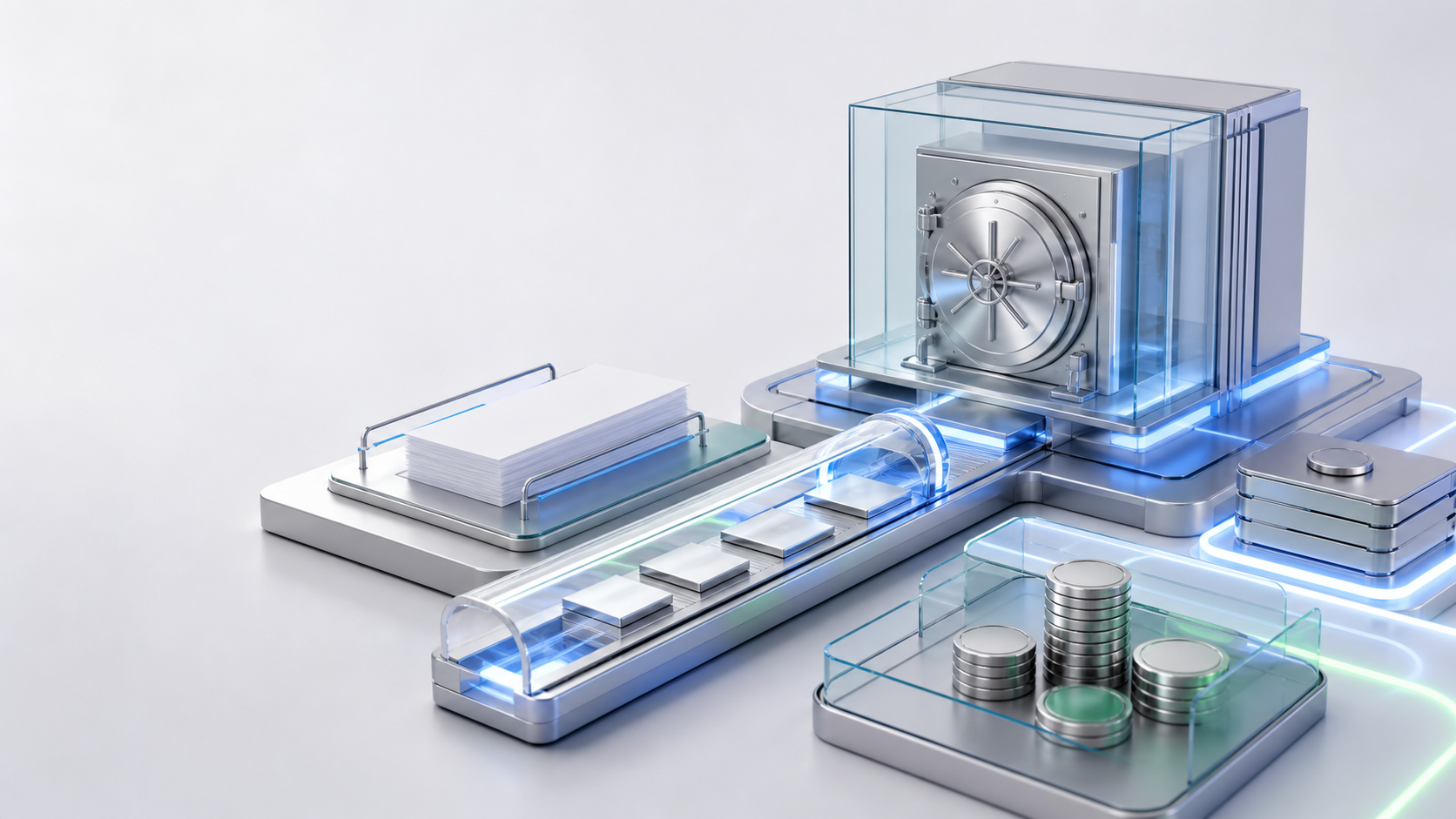
Case under NDA: what can be disclosed publicly
The name of the customer is not disclosed under the terms of the NDA, but the industry and project context can be described without confidential details: this is a bank from the top 5 of the Uzbekistan market, for which RESTART created an industrial AI environment for corporate knowledge, client and internal channels.
The solution successfully passed the pilot test, was accepted by the customer and is now being supported: the team supports the platform, develops knowledge bases, access channels, quality of answers and scenarios for further scaling.
The public description does not contain internal addresses, tokens, configurations, contractual data, proprietary metrics or personal data of the customer’s employees.
What RESTART implemented
In the project, RESTART introduced not a separate chatbot, but a managed AI platform of an enterprise level: a layer of search, response generation and automation on top of documents, regulations, knowledge bases, SharePoint, internal portals and user channels.
The platform is designed as an enterprise environment: data sources, access rights, indexing, RAG, models, prompts, logs, admin panel, connection channels, quality metrics and safe operation rules work together.
RAG agents and knowledge bases
Answers user questions regarding internal and external knowledge based on approved sources.
Omnichannel interfaces
Web chat, mobile application, corporate portal, chat bot and voice messages in familiar channels.
Admin and document manager
Management of documents, knowledge bases, users, access rights, response quality and content updates.
Security and governance
Separation of environments, access roles, audit, control of personal data, bank secrecy and corporate policies.
Enterprise integration
SharePoint, CRM, ERP, Service Desk, DWH, BI, internal portals, APIs and future agent actions.
Industrial support
Post-pilot support, quality monitoring, prompt tuning, knowledge base updating and preparation for scaling.
Three knowledge bases in one environment
The key feature of the project is not one universal knowledge base, but several managed environments for different audiences, access policies and service channels.
External users
The customer knowledge base is connected to the bank’s mobile application or external chatbot. The AI agent answers standard questions, supports multilingual communication and reduces the load on the first line.
Bank employees
The internal knowledge base is accessible via web chat and document manager. Employees quickly find regulations, instructions, procedures and answers to corporate systems.
SharePoint subservice
A separate environment integrates with MS SharePoint and provides a single window of access to documentation located on different sites and sections of the corporate portal.
Unified quality rules
Each loop has its own sources, roles, access rules, test questions, logs, and quality metrics, but relies on a common platform approach.
How RAG Agent works
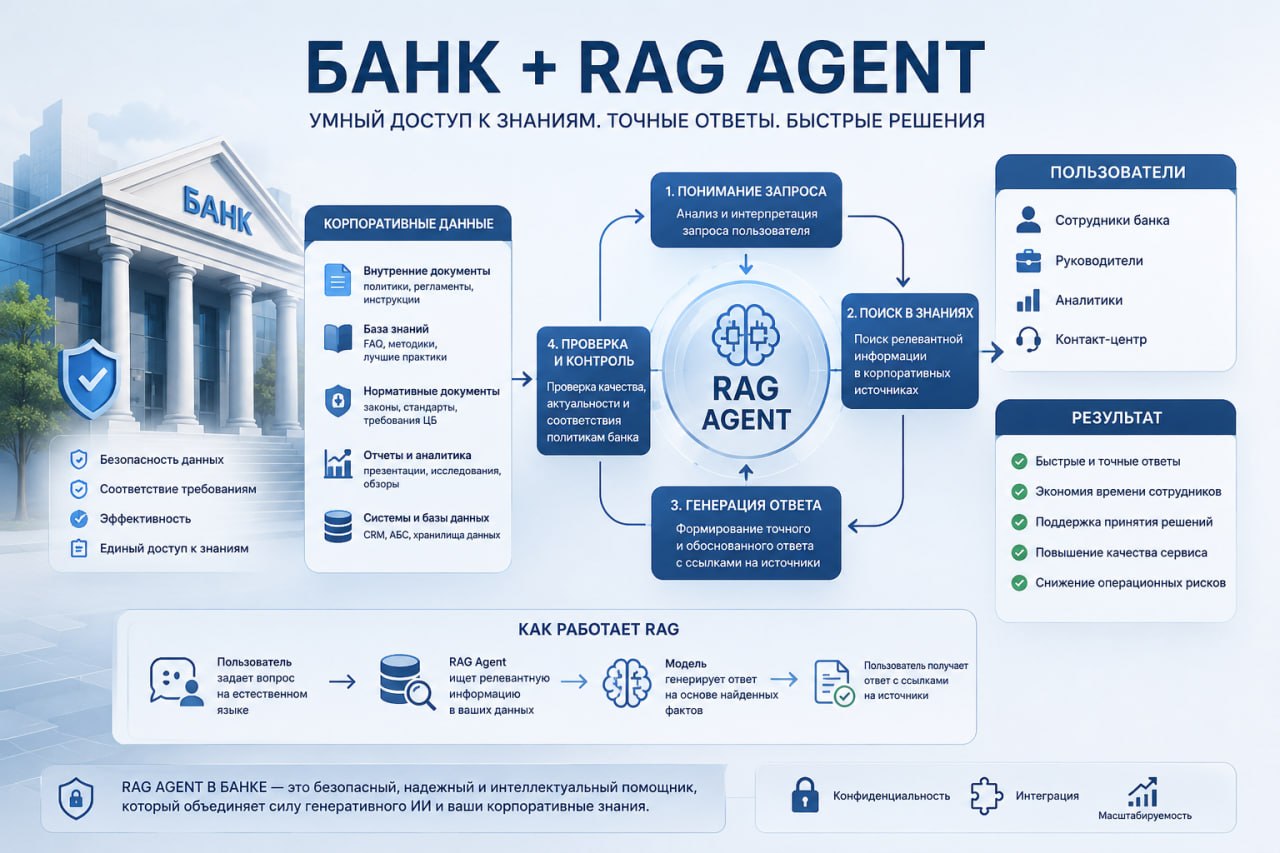
RAG Agent integrates corporate knowledge sources, query verification, search for relevant fragments and response generation with control of source links. The user receives a quick response in a familiar channel, and the company maintains control: access, audit, security, quality and scaling.
Understanding the request
Classification of intent, language, context, channel, and user role.
Check and control
Checking access rights, security policies, data restrictions, and response validity.
Search in knowledge
Search through indexes, documents, regulations, CRM/ERP data, SharePoint and other approved sources.
Generating a response
Generating a response in natural language with links to sources and taking into account corporate rules.
Output to channel
Web, mobile application, corporate portal, chatbot, voice messages or API.
Audit and improvement
Logs, quality metrics, user feedback, prompt tuning and knowledge base updating.
Technical outline of the AI platform
Behind the RAG review logic is an industrial backend environment for knowledge, search and response generation.
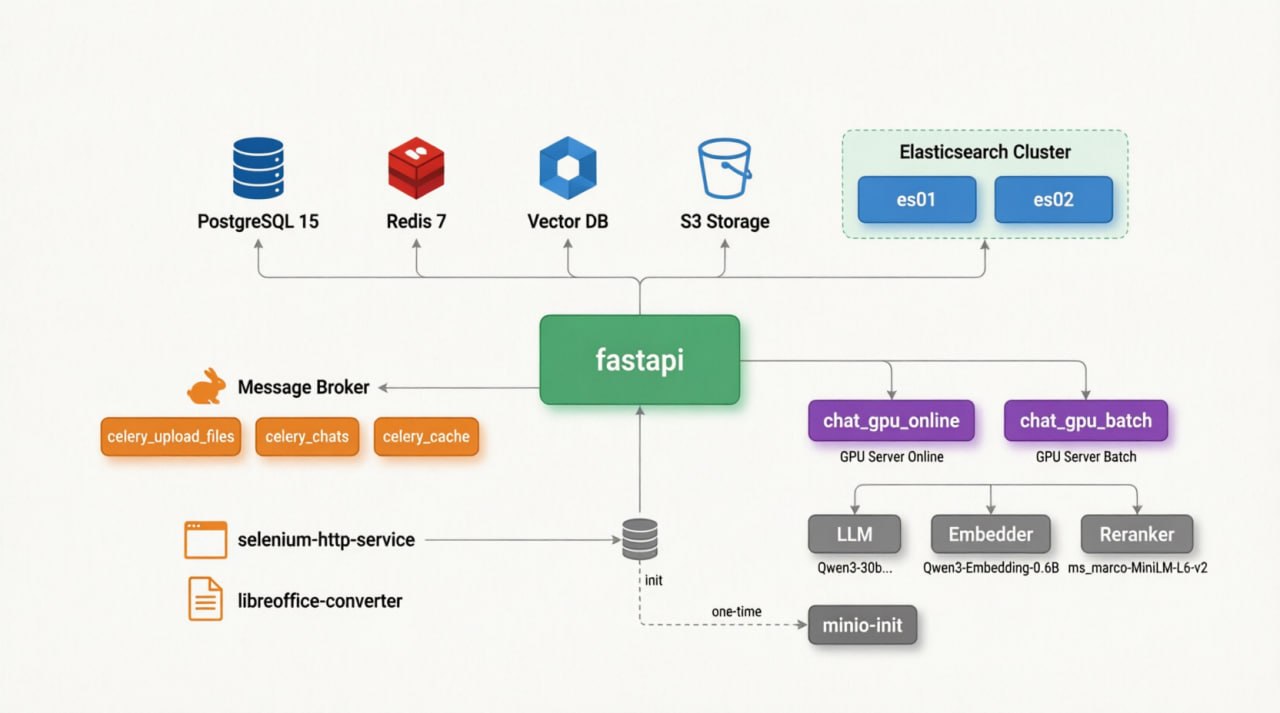
The platform layer works as a single integration point for files, chats, vector search and response generation. FastAPI accepts application queries, PostgreSQL and Redis store state and operational data, Vector DB and Elasticsearch are responsible for searching, S3 storage holds files, and the GPU environment serves LLM, embedding model and reranker.
Measurable business effects of an AI platform
Effects depend on data maturity, knowledge base quality, current support workload, integrations, security requirements, and use cases. On a project, RESTART records the baseline before the pilot, then measures the result on the pilot group and only after that scales the solution.
| Capability | What we measure | Pilot target | Benchmark of world practice |
|---|---|---|---|
| Customer support | share of standard questions closed without an operator | 15-35% after filling the knowledge base | McKinsey estimates the potential for reducing human-serviced contacts by up to 50% depending on initial automation. |
| Agent productivity | resolved requests per hour | +10-20% on the pilot group | NBER Working Paper 31161 shows an average increase in customer support productivity of about 14% with AI-based suggestions. |
| Search for information by employees | time to search for regulations and documents | -20-30% on standard requests | Forrester TEI for Microsoft 365 Copilot provides time savings on information search of about 29.8%. |
| Preparation of texts and answers | time to draft answers and instructions | -20-35% on typical tasks | Forrester TEI shows significant time savings on content creation and email writing. |
| Quality of knowledge | share of responses with a link to the source | 80-95% for documents in the knowledge base | The RAG approach increases testability by citing sources and test question sets. |
| Internal IS support | tickets and calls on typical issues | -10-25% of typical requests | The effect depends on the quality of instructions, access roles and integration with Service Desk. |
RESTART does not promise a universal cost reduction percentage. The correct approach is to determine the baseline, agree on the pilot’s KPIs, test the effect on a limited group, and only after that make a decision about replication.
Pilot and support KPIs
To move from demonstration to production, it is important to measure not only the number of requests, but also the quality of the response, knowledge coverage, security and the actual offload of teams.
Adoption
The number of active users, repeat requests, usage channels and scenarios where AI actually entered the workflow.
Deflection
The share of typical questions closed by an AI agent without an operator, and the share of correct escalations per person.
Quality
The share of answers with a link to the source, the completeness of the answer, the share of incorrect or incomplete answers, user rating.
Knowledge coverage
The number of documents in the knowledge base, coverage of critical topics, update speed after changes in regulations.
Security
Access events, policy violations, attempts to request inaccessible documents, correct role delimitation.
Operations
Platform support SLA, response time to incidents, index stability, quality of logs and monitoring.
AI in a secure banking environment
For a bank, an AI platform should not be an experiment, but a controlled component of the IT architecture. Therefore, RESTART designs an AI environment taking into account roles, access rights, logging, information security requirements, personal data, banking information and internal policies of the customer.
Access control
The user sees only the knowledge and documents to which he has the right in the agreed access model.
Path separation
The internal and external loops can be deployed separately, with different sources, policies, SLAs and scenarios.
Source control
Answers are based on approved documents and knowledge bases, and not on random data or unconfirmed generation.
Audit and logs
Requests, responses, sources, errors, escalations, administrator actions, and user feedback are recorded.
Human-in-the-loop
For critical scenarios, human verification, escalation, or prohibition of automatic response is provided.
Federal Law No. 152-FZ and policies
Personal data, trade secrets and banking information are processed only in an agreed upon architecture.
From implementation to industrial support
The project route was built as a transition from a limited pilot to managed support and development. This approach reduces the risk that AI will remain a beautiful demonstration without owners, metrics, operation and knowledge updating.
Discovery and architecture
Scenarios, sources of knowledge, information security requirements, roles, pilot KPIs and public/internal boundaries.
Deploying the environment
Infrastructure, environments, access rights, base platform, logs and operating rules.
Filling the knowledge base
Documents, indexes, test set of questions, access roles and the process of updating materials.
Channel integration
Web chat, portal, SharePoint, mobile channel, chatbot, voice messages or API.
Testing and tuning
Pilot group, feedback, setting prompts, policies, search quality and escalation rules.
Support and development
Platform maintenance, knowledge updating, quality monitoring, scenario expansion and preparation for replication.
Deployment and Infrastructure
The AI platform can be deployed in the customer’s infrastructure, in a dedicated private cloud or in a hybrid model. The architecture is selected according to security requirements, load, number of users, frequency of calls, languages, channels and the need for dedicated environments for different user groups.
| environment | Role | What is specified before launch |
|---|---|---|
| Pilot environment | MVP, knowledge base check, first users | sources, access rights, test questions, model, logging, acceptance |
| Internal production | employees, regulations, SharePoint, portal | SLA, reservations, roles, logging, monitoring, support |
| External production | customer channels and first line | load testing, security, response filtering, escalation scenarios |
| Dev/Test | development and testing of changes | data masking, test indexes, release process, DevSecOps |
The final infrastructure parameters are determined after load testing and evaluation of real-life scenarios. RESTART can connect AI Compute, DevOps/DevSecOps and information security practices as a single delivery loop.
Where is the solution going?
After launching the knowledge base, the AI platform can develop towards multimodal document processing and workflow automation: receiving incoming documents, retrieving details, preparing draft responses, routing applications, checking for completeness, generating draft transactions and integration with ERP/1C/Service Desk.
Application Agent
Acceptance, cancellation, status clarification, routing and operator tips based on data from the systems.
AI Service Desk
Classification of requests, first-line knowledge base, SLA control and tips for support staff.
SharePoint Knowledge AI
Unified search and answers for distributed documents, regulations and materials of departments.
Document AI
Processing of payments, invoices, receipts, claims, contracts and investments.
ERP/1C integration
Draft entries, reconciliations, ledgers, documents, financial comments and management analytics.
Security/GRC AI
Assistant for information security, compliance, policies, incidents, requirements, reports and control procedures.
Related products and services RESTART
The case shows the strengths of RESTART: the AI platform requires not only a model and interface, but also data, security, integrations, DevOps, support and understanding of the banking enterprise environment.
Frequently asked questions
Why can't you name the bank?
The project is under NDA. We may disclose industry context, solution class, implementation status, and anonymized architecture, but we do not publish customer name, internal metrics, configurations, addresses, documents, or personal information.
How does a RAG agent differ from a regular chatbot?
A regular chatbot often works according to predetermined scenarios. The RAG agent searches for relevant fragments in corporate knowledge sources and generates a response taking into account the context, access rights and links to sources.
Is it possible to deploy an AI platform within the customer’s infrastructure?
Yes. For regulated companies, on-premise, private cloud and hybrid options are possible. The architecture depends on information security requirements, load, data composition, access channels and customer policies.
Is it possible to connect SharePoint, 1C, ERP, CRM or Service Desk?
Yes. The platform is designed as an integration layer on top of corporate knowledge sources and systems. The connection is made through APIs, connectors, uploads, document indexing or specialized integrations.
How is the quality of responses controlled?
Quality is controlled through test sets of questions, links to sources, user feedback, log audits, human-in-the-loop for critical scenarios and regular knowledge base updates.
What happens after implementation?
After acceptance, the platform goes into maintenance: knowledge bases are updated, quality is controlled, new scenarios are configured, users are supported, and scaling to new contours is prepared.
How it goes implementation of AI in business - from inspection to operation - on the directions page.
Discuss a similar AI environment
If you have a knowledge base, portal, SharePoint, Service Desk, mobile application or internal regulations, let's start with a short discovery: we will determine the sources of knowledge, user scenarios, security requirements and pilot KPIs.
Email usDiscuss a similar project
Tell us about your task and outline - we’ll show you how to apply this experience to you and offer the first practical step.